 Complete Leave-Behind Guide
Career-Connected Learning:
Scope & Sequence Guide
Connecting daily classroom instruction to high-value careers across Math, Career Exploration, Financial Literacy, and Labor Market Intelligence.

Table of Contents
This all-in-one guide brings together the mission, research foundation, full curriculum scope and sequence, effectiveness evidence, and implementation steps for the Pathway2Careers (P2C) Career-Connected Learning Suite.
| Section | Title | Focus | Page |
|---|---|---|---|
| Section 1 | About Pathway2Careers (P2C) | Mission, vision, and evidence-based foundation | 3 |
| Section 2 | Why CCL Is Important | Replacing "When will I ever use this?" with purpose | 4 |
| Section 3 | The Problem & What Research Says | National readiness gaps, engagement data, and CCL impact | 4 |
| Section 4 | Our Solution | The P2C Career-Connected Learning Suite ecosystem | 6 |
| Section 5 | P2C Math & P2C Math Bridge | 4-year core math, 175 Bridge lessons, and usage framework | 6 |
| Section 6 | P2C Career Explorer & Employability | 119 lessons, 16 clusters, 27 soft-skill lessons, 12 benefits | 11 |
| Section 7 | P2C Financial Literacy | 7 pillars (Earn, Plan, Save, Invest, Spend, Borrow, Risk) | 14 |
| Section 8 | LMN, PD & School Services | Labor Market Navigator, coaching, and Early College support | 15 |
| Section 9 | Does It Work? Our Effectiveness | New Mexico field outcomes, UofL CRIMSTED, EIR RCT | 15 |
| Section 10 | Next Steps: Book a Demo & Contact | Implementation roadmap, demo booking, and sources | 17 |
Every P2C curriculum and tool is built to answer students' most urgent question—"Why does this matter for my future?"—while equipping districts with turnkey, standards-aligned instruction backed by local labor market data (p2c.org).
About Pathway2Careers (P2C)
At Pathway2Careers™ (P2C), developed by NS4ed LLC, we believe that when education becomes relevant, learners fully engage. Our mission is straightforward: revolutionize education by challenging the current approach and motivating student learning through career-connected relevance.
This mission drives our vision of improving students' prospects by connecting the time and energy they spend in the classroom with meaningful career paths. In doing so, we aim to transform not just the future prosperity of individual students, but the economies of entire communities.
Rigorous Evidence-Based Design
Every product, resource, and strategy is grounded in research led by our in-house evaluation team and independent university partners, ensuring career-connected experiences are both innovative and effective.
Nearly a Decade of Impact
P2C partners with states, school districts, and education cooperatives nationwide to deliver ready-to-implement curricula, labor market dashboards, and Early College coaching (K-12 Dive).

Why Career-Connected Learning (CCL) Is Important
Across middle and high school classrooms, educators face the same recurring question from students: "When will I ever need to know this in the real world?" Traditional instruction often separates academic standards from the careers and financial realities students will navigate after graduation.
Career-Connected Learning (CCL) bridges that divide. Instead of treating career readiness as an isolated elective or a one-day career fair, high-quality CCL embeds authentic career contexts directly into daily graded instruction (Aspen Institute).
Four Core Reasons CCL Matters for Every Student
1. Replaces Doubt with Purpose
When "Why do I have to learn this?" becomes "I know why this matters," students see how daily academic objectives power future career options (p2c.org).
2. Serves All Pathways, Not Just One Track
CCL benefits every learner—whether pursuing medicine, engineering, business, education, technology, or skilled trades—without locking students into rigid tracks (Aspen Institute).
3. Grounds Choices in Local Economies
Connecting instruction to regional labor market data helps students discover high-value, high-growth careers right in their own communities.
4. Builds Durable Workplace Skills
Employers consistently cite shortages in communication, critical thinking, and collaboration—skills developed alongside core academics through CCL (Aspen Institute).
The Importance of CCL: The Problem & What Research Says
National assessment and student-voice data reveal a persistent gap between what schools teach and what students need to thrive in college, careers, and life. Career-connected learning directly addresses both academic readiness and student engagement.
What National Research Shows
| Research Area | Key Finding | Source |
|---|---|---|
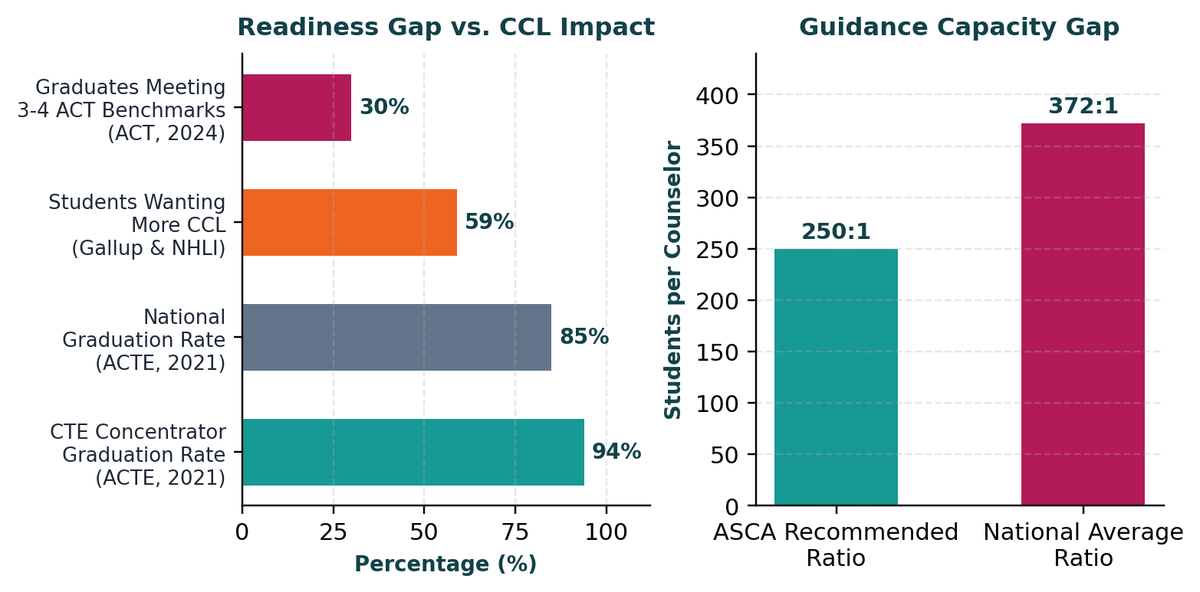
| Readiness & Math Gap | Only 30% of 2024 graduates met 3 or 4 ACT college readiness benchmarks, while 2024 NAEP 12th-grade math and reading scores hit historic lows. | EdTech Digest |
| Guidance Capacity | The national student-to-school-counselor ratio stands at 372-to-1, far exceeding ASCA's recommended 250-to-1—leaving classroom teachers as key career guides. | EdTech Digest |
| Student Demand | 59% of students report wanting more opportunities for career-connected learning, and Gallup's study of 110,000+ students links engagement and hope to achievement. | Gallup / eSchool News |
| Graduation & Mobility | CTE concentrators achieve a 94% average graduation rate versus 85% nationally, and quality CCL is linked to higher employment rates and long-term earnings. | P2C / ACTE; Aspen |
Our Solution: The P2C Career-Connected Learning Suite
While national policy emphasizes what is needed to bridge K–12 education and workforce readiness, Pathway2Careers delivers the how (K-12 Dive). Our integrated suite combines labor market intelligence, core math, career exploration, financial literacy, and educator support.
| P2C Solution | Grade / Scope | Core Purpose & Differentiator |
|---|---|---|
| P2C Math & Math Bridge | Grades 6–12 (Core) & 4–7 Skills (Bridge) | Four full-year core math courses (500+ lessons) plus 175 scaffolded Bridge lessons integrating 650+ real occupations and Quantile® measures. |
| P2C Career Explorer | Grades 6–12 (Levels 1–7) | 119 cross-curricular lessons across all 16 National Career Clusters, 27 Employability Skills lessons, 32 Career Stories, and My Career Page. |
| P2C Financial Literacy | Grades 6–12 (7 Units) | 73 lessons across Earn, Plan, Save, Invest, Spend, Borrow, and Risk, pairing personal finance with BLS career data and the PACED model. |
| P2C Labor Market Navigator (LMN) | District & Regional Dashboard | Customized social, economic, and demographic data dashboard—the fuel powering P2C Math and Career Explorer with local job trends. |
| PD & School Services | Educators & Leadership | Prescriptive professional development, online learning communities, Early College High School technical assistance, and executive coaching. |
Unlike generic career platforms, P2C Labor Market Navigator connects every math problem, career profile, and financial budgeting exercise to real local wages, job openings, and regional employers.
Solution Summary 1: P2C Math & P2C Math Bridge
P2C Math delivers four full years of vertically aligned math instruction—Pre-Algebra, Algebra I, Geometry, and Algebra II—developed using Understanding by Design (UbD) and Universal Design for Learning (UDL) principles. Each course integrates Quantile® and Lexile® measures from MetaMetrics®, plus Beginning-, Middle-, and End-of-Year (BOY/MOY/EOY) assessments.
Three Lesson Types in Every Unit
Exploration & Application Lessons
Exploration builds conceptual mastery across multiple contexts; Application embeds math directly into a Career Spotlight (e.g., Manufacturing Engineers, Geological Technicians, Carpenters, Network Support Specialists).
Information Technology (IT) Projects
Multi-day culminating projects ("P", 3–6 days) pair math standards with high-demand tech roles such as Web Developers, Database Architects, and Information Security Analysts.
Career Spotlights in Action: Real Math, Real Wages




Pre-Algebra Scope & Sequence (111–182 Days | 930L)
| Chapter | Days | Key Topics & Featured Career Connections |
|---|---|---|
| 1. Transformational Geometry | 13–21 | Translations, reflections, rotations, symmetry, dilations (CNC Programmers, Automotive Engineers, Interior Designers) |
| 2. Equations & Inequalities | 14–23 | Rational operations, one/two/multi-step equations, break-even problems (Facilities Managers, Loan Officers, Registered Nurses) |
| 3. Angle Relationships | 6–11 | Parallel lines, triangle angles, AA similarity, IT Geometry Project (Structural Iron Workers, Robotics Engineers, Firefighters) |
| 4. Proportional Relationships | 11–19 | Proportions, slope, percents, graphing (Compliance Officers, Surveyors, Food Scientists, Manufacturing Engineers) |
| 5. Functions | 14–21 | Linear functions, rate of change, intercepts, nonlinear functions, IT Project (Dental Hygienists, Commercial Pilots, Civil Engineers) |
| 6. Systems of Linear Equations | 10–17 | Graphing, substitution, elimination, mixture & tolerance problems (Credit Counselors, Personal Financial Advisors, Chemists) |
| 7. Statistics & Probability | 11–17 | Scatter plots, trend lines, two-way frequency tables, IT Project (Medical Scientists, Data Scientists, Operations Research Analysts) |
| 8. Exponents & Scientific Notation | 12–21 | Properties of exponents, orders of magnitude, scientific notation (Software Developers, Industrial Ecologists, Geoscientists) |
| 9. Real Numbers & Pythagorean Thm. | 10–16 | Square/cube roots, irrational numbers, converse, IT Project (Landscape Architects, Plumbers, Building Inspectors) |
| 10. Measurement & Volume | 10–16 | Circles, cylinders, cones, spheres, composite solids (Market Research Analysts, Chefs, Heavy Equipment Mechanics) |
Algebra I Scope & Sequence (126–185 Days | 980L)
| Chapter | Days | Key Topics & Featured Career Connections |
|---|---|---|
| 1. Algebra Foundations | 8–12 | Real numbers, dimensional analysis, expressions, IT Project (Dental Lab Technicians, Terrazzo Workers, Database Architects) |
| 2. Solving Equations | 7–11 | One/two/multi-step equations, literal equations & formulas (Credit Counselors, Veterinarians, Bookkeeping Clerks, Electricians) |
| 3. Solving Inequalities | 9–13 | Compound & absolute value inequalities, graphing (Property Managers, Billing Clerks, Exercise Physiologists) |
| 4. Functions & Linear Functions | 14–21 | Rate of change, point-slope form, lines of fit, IT Project (Fitness Trainers, Geological Technicians, Hydrologists, Cost Estimators) |
| 5. Systems of Equations & Inequalities | 11–16 | Linear systems & inequalities, IT Project (Chefs, Application Software Developers, Industrial Engineers, GIS Technicians) |
| 6. Exponents & Exponential Functions | 10–17 | Radicals, exponential growth & decay (Accountants, Animal Scientists, Forensic Technicians, Epidemiologists) |
| 7. Sequences | 8–12 | Explicit & recursive arithmetic and geometric sequences (Operations Managers, Actuaries, Sociologists) |
| 8. Polynomials & Factoring | 12–16 | Polynomial operations, factoring quadratics, IT Project (Astronomers, Operations Research Analysts, Video Game Designers) |
| 9. Quadratic Functions & Equations | 13–19 | Vertex/intercept form, quadratic formula, linear-quadratic systems (Aerospace Engineers, Physicists, Economists) |
| 10. Graphing & Modeling Functions | 11–15 | Absolute value, step, piecewise functions, IT Project (Cargo Agents, Tax Preparers, Film Editors, Business Intelligence Analysts) |
| 11. Radical Expressions & Inverses | 12–17 | Square/cube root functions, inverse functions, IT Project (Radiologic Technologists, Mechanical Engineers, Wind Turbine Techs) |
| 12. Statistics | 11–16 | Center & spread, box plots, histograms, two-way tables, IT Project (Statisticians, Financial Examiners, Search Marketing Analysts) |
Geometry & Algebra II Scope & Sequence
| Course | Pacing / Lexile | Chapters & Featured Career Connections |
|---|---|---|
| Geometry | 126–190 Days 960L |
13 Chapters: Geometry Fundamentals, Reasoning & Proofs, Parallel/Perpendicular Lines (IT Project), Transformations, Congruent Triangles, Triangle Relationships, Polygons (IT Project), Similarity, Right Triangles & Trig, Circles (IT Project), Circumference & Area, Surface Area & Volume, Probability & Decision Making (IT Project). Careers include Occupational Therapists, EMTs, Civil Engineers, Air Traffic Controllers, Solar Installers, and Geoscientists. |
| Algebra II | 126–212 Days Part A & B |
Part A (10 Chapters): Expressions & Equations, Linear Functions, Linear Systems, Matrices (IT Project), Quadratic Functions, Absolute Value & Piecewise, Polynomials, Radical Functions, Discrete Math & Combinatorics, Data. Part B (2 Core + 3 Extension Chapters): Rational Functions, Conic Sections, Complex Numbers, Exponential & Logarithmic Functions (IT Project), Trigonometry, Vectors, Series & Sequences, plus Extension Units in Binary/Hexadecimal, Topology, and Logic. |
P2C Math Bridge: 175 Lessons Closing Grades 4–7 Gaps
P2C Math Bridge provides 175 scaffolded "Illustration" lessons across 14 units (150–195 days). Vertical Alignment & Pacing Guides insert Bridge lessons directly before corresponding Pre-Algebra, Geometry, and Algebra I lessons for proactive pre-teaching or targeted RTI/MTSS intervention.

| Bridge Units 1–7 (Foundational Arithmetic & Pre-Algebra) | Bridge Units 8–14 (Functions, Data & Geometry) |
|---|---|
| 1. Understanding Fractions & Decimals (15 lessons) 2. Products, Quotients & Estimation (11 lessons) 3. Exploring the Number System (9 lessons) 4. Factors, Multiples & Patterns (14 lessons) 5. Exploring Exponents (12 lessons) 6. Algebraic Expressions & Equations (13 lessons) 7. Rates, Ratios & Percents (14 lessons) |
8. Evaluating & Understanding Functions (13 lessons) 9. Data Displays (13 lessons) 10. Probability (10 lessons) 11. Geometry Foundations (16 lessons) 12. Proportions & Transformations (12 lessons) 13. Two-Dimensional Figures (15 lessons) 14. Three-Dimensional Figures (8 lessons) |
P2C Math Supplemental Usage Framework
| Instructional Use Case | Recommended Dosage | Implementation Focus |
|---|---|---|
| Supplemental / Enrichment | ~2–3 lessons / month | Align Application lessons to current units using station rotations or culminating projects. |
| Intervention (RTI / MTSS) | 1–2 sessions / week (20–40m) | Deploy Math Bridge lessons in small groups or tutoring; track progress via diagnostic checks. |
| Acceleration & Gifted | 1–2 times / month | Assign multi-day P2C IT Projects requiring deeper inquiry and cross-curricular synthesis. |
| Career / CTE Integration | ≥ 1 career lesson / unit | Use the Math-in-CTE model (~10% explicit math focus) and collaborate with CTE teachers. |
| Special Ed & Inclusion | 1–2 lessons / week (per IEP) | Leverage UDL multimodal representations, step-by-step scaffolds, and interest-aligned careers. |
| Engagement, SEL & DDI | Biweekly / Ongoing | Use Career Vignettes, CASEL goal-setting prompts, and weekly Quantile®-aligned DDI checks. |
Solution Summary 2: P2C Career Explorer & Employability Skills
P2C Career Explorer is a guided, cross-curricular career exploration system for Grades 6–12. Beyond standalone career quizzes, it delivers 119 ready-to-use lessons across Levels 1–7 aligned to ELA, Math, Science, Social Studies, and all 16 National Career Clusters.

Four Core Components & 7-Level Progression
P2C Career Tools
Interactive self-assessments—Interests Matcher, Values Matcher, Cluster Matcher, and Knowledge & Skills Matchers—paired with regional labor market data.
Career Exploration Curriculum
119 lessons (Levels 1–7) with dual academic and career learning objectives, from ROI analysis (CE-3.4) to regional employer interviews (CE-5.5).
Career Story Playlist
32 lessons centered on authentic career narratives of real professionals across all 16 career clusters, giving students a window into diverse pathways.
My Career Page Portfolio
A centralized digital portfolio where students save artifacts, reflections, and bookmarked careers to share with educators, colleges, and employers.
| Levels | Grade Band Focus | Sample Lesson Highlights Across Core Subjects |
|---|---|---|
| Levels 1–2 | Middle Grades Intro | That's Very Interesting (ELA), High-Value Careers (Math), Math & Science Movers and Shakers (Science), Beyond the Horizon (Social Studies). |
| Levels 3–4 | Transition to High School | Connecting the Data Dots (Math), Unpacking STEM Myths (Science), How Do I Define High-Value Occupations? (Math), Tricks of the Trade (YEP). |
| Levels 5–7 | Upper High School & Postsecondary | Diving into Labor Market Data (Math), Flipping the Script: Interviewing Employers (ELA/SS), Self-Assessment ROI Cycle (Math), Road Warriors (Career Roadmap). |
Employability Skills Playlist (27 Lessons)
Embedded within Career Explorer, the Employability Skills Playlist builds workplace competencies across Beginner, Intermediate, and Advanced levels in nine essential domains:
| Effective Relationships | Workplace Skills | Applied Knowledge |
|---|---|---|
| • Interpersonal Skills (ESP-1.1–1.3) • Personal Qualities (ESP-2.1–2.3) |
• Resource Management (ESP-3.1–3.3) • Information Use (ESP-4.1–4.3) • Communication & Active Listening (ESP-5.1–5.3) • Systems Thinking (ESP-6.1–6.3) • Technology Use & Cybersecurity (ESP-7.1–7.3) |
• Critical Thinking & Problem Solving (ESP-8.1–8.3) • Applied Academic Skills & SMART Goal Setting (ESP-9.1–9.3) |
12 Student Benefits of Guided Career Exploration


| Self-Discovery & Decision-Making (1–6) | Preparation & Motivation (7–12) |
|---|---|
| 1. Early Self-Discovery: Explore interests, values, and abilities. 2. Personal Growth: Build self-awareness and confidence. 3. Career Awareness: Discover high-value career options. 4. Data-Driven Decisions: Evaluate regional labor market data. 5. Career Preparation: Map required training and credentials. 6. Core Subject Alignment: Connect exploration to daily classes. |
7. Holistic Approach: Blend financial literacy and STEM. 8. Flexibility: Adaptable across grade levels and readiness. 9. Collaborative Learning: Classroom discussion and peer sharing. 10. Portfolio Development: Build My Career Page for applications. 11. Decision-Making Skills: Apply structured life-choice frameworks. 12. Motivation & Goal-Setting: Establish clear academic direction. |
Solution Summary 3: P2C Financial Literacy
P2C Financial Literacy combines essential money management with real-world career exploration across 73 standalone, playlist-ready lessons organized into seven pillars. Students apply Bureau of Labor Statistics (BLS) wage data and the PACED Decision-Making Model (Problem, Alternatives, Criteria, Evaluate, Decision) to evaluate education ROI, paychecks, credit, and long-term wealth.
| Unit | Lessons | Core Topics & Student Outcomes |
|---|---|---|
| 1. Earn | FL-1.1 – 1.9 (9 lessons) | Opportunity cost, PACED model, BLS wage exploration, degree ROI, compensation types, employee benefits, tax foundations, W-4 forms, entrepreneurship. |
| 2. Plan | FL-2.1 – 2.10 (10 lessons) | Goal setting, fixed vs. variable expenses, budgeting from career projections, government careers, job-posting analysis, Career Analysis Project. |
| 3. Save | FL-3.1 – 3.10 (10 lessons) | Checking vs. savings, banks vs. credit unions, high-yield accounts, fixed-income & CDs, Social Security, IRAs, 401(k)s, inflation & CPI, Effective Budgeting Project. |
| 4. Invest | FL-4.1 – 4.13 (13 lessons) | Compound interest, equities & risk, Stock Market Simulation, Federal Reserve & SEC regulation, investment careers, real estate, crypto, Retirement Planning Project. |
| 5. Spend | FL-5.1 – 5.9 (9 lessons) | Spending influences, needs vs. wants, impulse buying, Cash/Debit vs. Credit, scam prevention, advertising analysis, consumer rights, vehicle leasing vs. buying. |
| 6. Borrow | FL-6.1 – 6.11 (11 lessons) | Credit reports & FICO scores, credit card responsibility, good vs. bad debt, FAFSA & paying for college, renting vs. buying, mortgages, Responsible Borrowing Project. |
| 7. Risk | FL-7.1 – 7.11 (11 lessons) | Science of insurance, auto/home/renter's/health insurance, wealth & estate planning, elective insurance, Entrepreneurship Strategy Project. |
Students connect Math (multi-digit decimal operations) and Social Studies to distinguish gross vs. net income, sort payroll, income, sales, and property taxes, and calculate a realistic monthly take-home paycheck using a chosen career's median salary from the P2C Career Library.
Solution Summary 4: Labor Market Navigator, PD & School Services
Curriculum alone is not enough—districts need accurate local data and sustained educator support. P2C wraps its instructional products in three high-impact operational pillars:
P2C Labor Market Navigator (LMN)
P2C LMN is a customized dashboard featuring social, economic, and demographic data specific to a school district or region. It serves as the fuel powering P2C Math and Career Explorer—equipping educators to build community partnerships, personalize student pathways, and evaluate CTE programs against local hiring demand.
Prescriptive Professional Development (PD)
The P2C Professional Development team delivers tailored training experiences designed around each district's implementation model—including ongoing follow-up virtual sessions, collaborative online learning communities, and research-driven courses.
School Services & Innovation
P2C provides hands-on Technical Assistance for career readiness initiatives, specializing in Early College High Schools, executive leadership coaching, and Communities of Best Practice to ensure sustainable student outcomes (p2c.org/research).
Does It Work? Our Effectiveness & Evaluations
Pathway2Careers invests in rigorous internal and third-party evaluations to measure curriculum alignment, classroom usability, student attitudes, and academic outcomes (p2c.org/research).
Independent Reviews & Federal Research Partnerships
| Evaluation / Partner | Verified Findings & Scope |
|---|---|
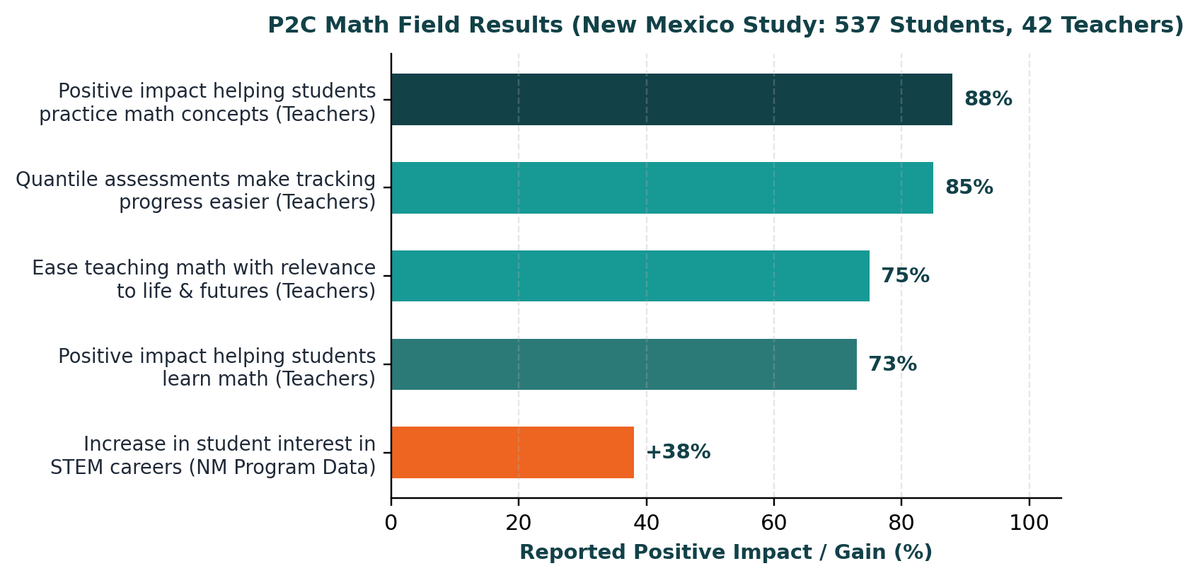
| New Mexico PED ($5M SEA Grant) | Survey of 537 students & 42 teachers found P2C Math improved student attitudes toward math and informed career/education plans; 88% of teachers reported positive practice impact and 85% reported easier progress tracking via Quantile® (Report). |
| Univ. of Louisville (CRIMSTED) | 71-page scholarly evaluation across 5 P2C Math courses confirmed complete standards coverage and 4 signature strengths: breadth of career integration, high-interest connections, comprehensive math ideas, and systematic multiple representations (p2c.org/research). |
| Federal EIR Tier-1 RCT | Dr. Joseph Goins & P2C Evaluation Team selected for an Education Innovation and Research (EIR) Mid-Phase Randomized Controlled Trial—highest-rated application nationally in 2021—powering Extending Equity into the Digital Workforce (EEDW) (p2c.org/research). |
| Bridge of Southern NM (FIPSE $5M) | Developed with NMSU STEM Outreach Center; surveys of 48 students (grades 8–12) and 18 core/CTE teachers showed P2C positively impacted stated career-readiness outcomes (p2c.org/research). |
| CMU METALS, Learning List & Apex | Ongoing external standards alignment (Learning List), HCI/platform usability research (Carnegie Mellon University METALS), and math attitude/performance studies (Apex Evaluation) (p2c.org/research). |
Next Steps: Book a Demo & Contact Us
Bringing career-connected learning to your district is straightforward. Whether you are launching a targeted math intervention with P2C Math Bridge, adopting core P2C Math, or rolling out Career Explorer and Financial Literacy district-wide, our team tailors implementation to your goals.
Schedule a Personalized Demo
Explore live lessons, sample kits, and regional labor market data with a P2C specialist at p2c.org/contact/.
Configure Your Regional Labor Market Navigator
Align curriculum career spotlights and pathways to the high-value occupations and employers in your local community.
Launch with Prescriptive PD & Coaching
Equip teachers with vertical alignment guides, pacing frameworks, and ongoing virtual coaching for immediate classroom impact.
Sources & References
- Pathway2Careers Overview & Products: https://p2c.org/
- P2C K-12 Education and Career Research (UofL CRIMSTED, EIR RCT, FIPSE, NM PED): https://p2c.org/research/
- Report Shows Powerful Results from P2C Math: https://p2c.org/report-shows-powerful-results-from-p2c-math/
- P2C Math Research-Based Use Cases & Implementation Guide: https://47377131.fs1.hubspotusercontent-na1.net/hubfs/47377131/P2CMath_UseCaseResearch.pdf
- Success Through Career-Connected Learning (ACTE Data): https://p2c.org/success-through-career-connected-learning/
- Aspen Institute — Pathways, Not Pitfalls: Career-Connected Learning For All: https://www.aspeninstitute.org/wp-content/uploads/2026/06/Pathways-not-Pitfalls-FINAL-1.pdf
- Gallup & NHLI Student Demand / Engagement Research (eSchool News): https://www.eschoolnews.com/tag/gallup/
- ACT, NAEP & Counselor Ratio Data (EdTech Digest): https://www.edtechdigest.com/2026/04/28/the-missing-middle-in-career-connected-learning/
- K-12 Dive — Strengthening a Career Readiness Culture: https://www.k12dive.com/spons/5-steps-to-strengthening-a-career-readiness-culture/696861/
- Supplied P2C Kit Materials: P2C Math Sample Kit, P2C Math Bridge Sample Kit & Vertical Alignments, P2C Career Explorer Sample Kit & Flyer, 12 Student Benefits Infographic, P2C Financial Literacy Sample Kit, P2C Math Supplemental Usage Framework, and About Pathway2Careers Overview.